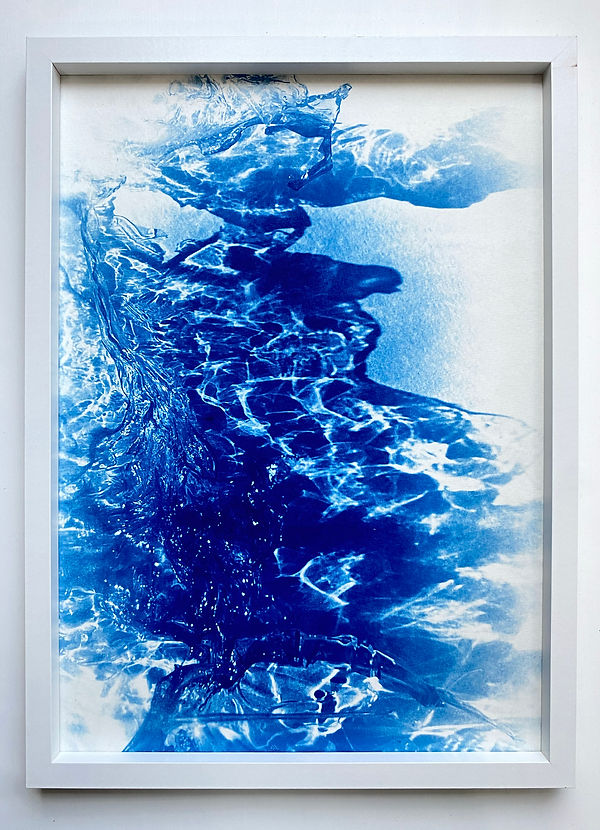

Bodies of Plastic, 2025
Cyanotype on watercolour paper, 42 x 29.7cm
Plastic has become one of the most pervasive materials on Earth. Once designed for durability and convenience, it now circulates through oceans, landscapes, and living organisms in ways that blur the boundary between the natural and the synthetic. Bodies of Plastic is a photographic exploration of this entanglement between environmental systems and the human body. Rather than depicting pollution as something distant or external,
Bodies of Plastic positions it within the intimate space of the body. Scientific research increasingly reveals that microplastics exist not only in oceans and rivers but also in drinking water, food systems, and human tissues. The project therefore reflects on a contemporary condition in which environmental contamination is no longer separate from the biological systems that sustain life.
The work reflects on the growing scientific awareness that microplastics circulate through both ecological and biological networks. Plastics have been identified in oceans, freshwater systems, air, food sources, and human tissue. These photographs therefore do not represent pollution as a distant environmental crisis, but rather as an intimate material presence—something that moves across the boundary between external landscape and internal body.
Light functions here as both illumination and transformation. Passing through plastic surfaces, it refracts, scatters, and produces unfamiliar textures that echo biological imagery. This optical transformation allows plastic to occupy a strange visual territory: at once seductive and unsettling, organic and synthetic. The images deliberately inhabit this tension, drawing attention to the aesthetic qualities of materials that simultaneously signify environmental degradation.
Bodies of Plastic ultimately considers plastic not as an inert object but as a material that actively participates in contemporary ecological conditions. By visually collapsing the space between oceanic environments and the human body, the work asks how we might understand ourselves within systems that we have materially altered. In a world saturated with plastic, the body is no longer separate from the environments it inhabits but increasingly composed through them.
